Monday, December 28, 2009

Rock 'n Roll Doesn't Have to be Noise Pollution


- It’s too loud!!!
- What???
- It’s too loud!!!
- What???
- TOO LOUD!!! *points at ear repeatedly*
- Not loud enough?!?! *reaches for volume*

Rock guitarists like to be loud. Whether it’s the Rolling Stones instructing their fans about the proper way to listen to Let it Bleed – “This record should be played loud,” or it’s Pete Townsend smashing his Les Paul to bits in front of a wall of Marshall stacks while the guitar screams in cascades of anguished feedback, volume has always been integral to the rock sound. There’s a reason that Gibson and Fender began to stick pickups on planks of wood in the 50’s; the genre of music evolving from the blues needed a more dramatic and aggressive sound.

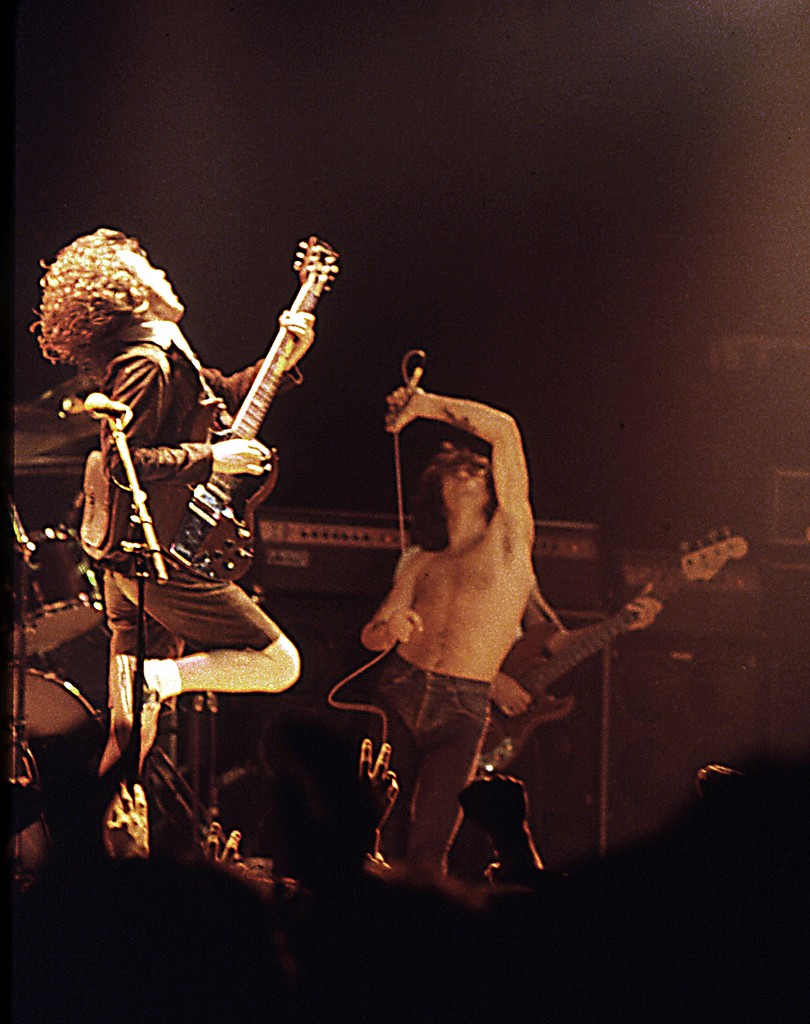
H’ok. So...how do you go about getting that awesome Malcolm-Young-rhythmic-chugging sound in your bedroom? Well, it’s easy enough. A quick Googling tells me that Young uses a Gretsch Firebird and Marshall JTM 45/100 and Superbass 100 amps.


Let’s for the moment assume that you have the requisite dinero to acquire this gear and a youthful spine, unswayed by the travails of a hard life. So you plug your guitar in and turn the amps on, turning the volume knob until you start to hear the amp humming (which is probably right around 1), and you launch into Back in Black...and...what the hell? Why does your amp sound like some beret-wearing jazz musician’s rig? This is a Marshall, right? You double-check the logo to make sure. Yup. What gives?

At this point, it’s a good idea to go back to the Stones’ words of wisdom. Play it Loud! Like all good tube amps, a Marshall needs to be turned up loud for that classic overdrive sound to come out. The only problem is that if you crank a 100 watt head to 10, you’ll be doing a Marty McFly impersonation.


You’ll also be homeless after you’re evicted, or if you’re unfortunate enough to own your domicile, you’ll have to look into how much it will cost to reinforce the structural integrity of your house. The point is that tube amps get mighty loud, mighty fast, but they don’t sound their best ‘til those tubes get cooking.

Yossarian!!!(?)!

Yes, it’s a catch-22.

One workaround is to use an overdrive or distortion pedal, which can simulate the sound of an overdriven amp at a lower volume. Which is all fine and dandy, except for the part where it’s simulating! A more authentic approach is to use an attenuator between your amp and speaker cabinet to attenuate (duh!) the signal after the amp has done it’s tubey goodness at ungodly volumes. This way, your amp gets cooking, creating the overdrive we want, but you can reign in the volume going to your speakers afterwards in order to keep it at neighbour-friendly levels.

Now, all attenuators aren’t the same and I’ve found that with my Marshall JTM45 head, the Dr. Z Airbrake was essentially useless. Even at full attenuation, it was still beyond pant-flapping loud. What did work for me, though, was a THD Hotplate. And boy, did it ever work!


While I happen to have a collection of nice guitar pedals, nothing beats the sustain and feel of a naturally distorting tube amp. There’s a sense of size and majesty that pedals seem unable to duplicate. The touch response is so much better too; strum lightly and you get less overdrive; dig in and you unleash awesomeness. A lot of pedals also have issues with the guitar’s controls. Rolling back the volume gives you a darker, less driven tone, but not a clean tone. With my cranked JTM45, when I roll back the volume, I get instant cleans that sound fantastic.

I had previously thought that having a Marshall stack at home was kind of pointless. Why have a big heavy-lifting amp when you can get a little flea-powered one and some pedals. Well, now I know better. The tones I get from my JTM45 are so much better than what I used to get from my Fender Blues Jr. that the comparison is frankly ludicrous. When you need overdrive, there is no substitution for a cranked Marshall, and something like the THD Hotplate lets you enjoy that sort of wantonness at home.

Thursday, November 26, 2009

Delayed Reaction

Delay is one of those effects that can fit in with every single song, as long as you know how to use it properly. Not every tune calls for Edge-like cascades of echo, but a judicious amount can really thicken up the tone of your guitar and really make it stand out. Remember: in myth, Echo vainly loved the sound of her voice until Hera stole it away from her. Don't go laying heavy delay everywhere, or you might find your voice taken away too - muted by the sound tech.

I have 3 primary setting that I use for delay. The first is my old standby: slap. A short delay of only 1 repeat, slapback delay is supposed to emulate the reverb effect of a small room, but it also gives you a cool doubling sound. As long as it's not set so long as to step on the toes of your next note, or so short that it isn't discernible from what you're actually playing, you should be able to really add a nice dimension to your sound.

My second setting is a standard U2-ish delay of about 300-ish milliseconds (give or take) with a 4 or 5 repeats. I use this for...ummm...U2 songs. I also like it for soloing and sometimes for playing clean arpeggiated passages.

Last, I have a setting that's just plain silly. I keep the delay at around 300 milliseconds, but crank up the repeats to just shy of the point of oscillation. I like to use this for atmospheric stuff. Also, it's what I use as an alternative to passages where I should be using a talk-box, like the beginning of Sweet Emotion.

My pedalboard has just undergone an overdrive upheaval, and there's also a delay rebellion happening simultaneously. I've been using my trusty DM-3 (the 2nd one I've owned) up until I found a great deal on an original Maxon AD-900. I'd been wanting one for a while, so I couldn't pass it up, even though I was hesitant about its footprint (much larger than the DM-3, but still smaller than the Electro-Harmonix Deluxe Memory Man I used to have).


I love analog delays. I had a Boss DD-3 for a while, as well as a Line 6 DL4 and an Ibanez DML20 III. The DD-3 was decent, but nothing special. The DL4 had some really neat features like reverse and stereo delay, but I always ended up using the analogue modeling delays on it anyway. The Ibanez could do some really weird and awesome things that I will never be able to replicate without it, but that wasn't enough to make me love it. For me, analogue delays have a certain simplicity, warmth and beauty to their tone that makes them superior to their digital brethren.

The DM-3 to me has been, for a long time, my go-to delay. I had one a while back which I traded for the Deluxe Memory Man because I wanted to give that pedal a go, and I'm glad I did because the Memory Man has a sound all its own which is beautiful and haunting, but I could never get comfortable with the pedal's size and ridiculous power requirement. I went back to another DM-3 and was happy til the Maxon showed up.

When I was A/B'ing the DM-3 and the AD900, I tried to set them as close to one another as possible, which was a bit tough because the AD900 has double the delay time of the DM-3, but I eventually got a nice slap effect from both. My first reaction was that the DM-3 was much darker than the AD900. I thought this might be more of the analogue-warmth-mojo, but the more I fiddled with settings, the more I came to the conclusion that the AD900 does a better job of replicating the original sound than the DM-3, which rolls of the highs so much that you get a very dark repeat that can easily get lost in a mix.

For now, the AD900 has usurped the DM-3's spot on the board, but I don't know for how long. The AD900 suffers the same two problems that led to the Memory Man's banishment. Too big and stupid power (it takes 12v instead of 9v, but at least it ain't 24v like the Memory Man). For the nonce, I'm gonna bask in the awesome repeats the AD900 gives me, but I might have to go back to the DM-3 again if I need the room. Maybe the third time will be the charm for the old Boss?

Tuesday, November 24, 2009

Chasing That Sound

Nothing gets me going quite like the sound of a snarling guitar. It doesn’t matter who’s playing it, sometimes you hear the sound of a guitar and it sounds so raw, so primal that you can’t help but listen. Listen to Izzy and Slash rip it up on Mr. Brownstone, Slowhand and Skydog on Why Does Love Got To Be So Sad?, Mark Knopfler on Money for Nothing or Rory Gallagher on Moonchild. How do you get a sound like that?

Well, to start, you need volume. Nothing sounds as good as a tube amp cranked up til the panels are hot enough to burn you on contact. The problem is that that kind of volume is a lease-breaker. So instead, we need to use pedals to mimic the sound of a cranked amp.

Overdrive pedals are to guitarists what shoes are to the average woman. You can never have enough, there’s no such thing as too expensive or too cheap, and you need at least one in every colour. It’s a good thing there’s literally hundreds of different ones to choose from. When I was recording songs for my originals project, I was heavily influenced by the blues and by alt country. This called for a much different type of sound than what I need for Molly’s Chamber. My main overdrive was a Fulltone Fulldrive-2, which gave me the flexibility of having a light and medium overdrive sound in one pedal, but I decided I really didn’t like stompboxes with more than one switch, so when I decided to look for a pedal for Molly’s Chamber, I decided to stick with Fulltone and go get one I’d always had my eyes on. The OCD.


Dropped the reverb, tremolo and wah. Added boost and compressor. Switch giant delay with more reasonable sized one.

The Obsessive Compulsive Drive is a fantastic pedal that really gives you that Marshall tone. It sounds big and ballsy but also reacts really well to picking dynamics and volume knob changes; I can easily dial back the volume to get a clean-ish sound. The problem with the OCD is that it’s a hugely compressed sound, which can get a bit mushy sounding at high volumes with a lot of overdrive. Also, I don’t really want to be riding my volume knob all the time. It’s one thing when you’re playing a Strat, but with the Les Paul, the volume knobs aren’t as easily accessible. So the quest began for a second pedal to complement the OCD.

My candidates at the moment are:
1 – Paul Cochrane Timmy
2 – Crowther Hotcake
3 – Tone Factor Mule

I thought the Mule would be great for that Black Crowes/Neil Young type sound. I’d dial it in for some tweedy crunch and use the OCD to rock out. Except I’d forgotten that the Mule suffers from something that has annoyed me in the past. NO TONE KNOB!!! My list of Cardinal Sins for a stompbox (especially, but not limited to overdrives) is:

1 – Having more than one footswitch
2 – No tone knob
3 – Being unnecessarily large
4 – Requiring ridiculous voltages

The Tone Factor Mule ended up being really bright sounding with my gear. I wanted to be able to hit a switch and change gears, but with the Mule it’s like changing cars! I definitely dug the way it sounded on its own, but it wasn’t going to work in the application I was looking to shoehorn it into.

The Crowther was a pretty interesting pedal. It almost committed the No-Tone-Knob sin, but alleviated that somewhat with a Presence knob, which I’ve never A) fully understood; or B) liked. In any case, I’d heard it was a fantastic low-medium gain pedal so here it was. I definitely dug it’s mojo at low gain, but I decided to crank it up to see what’s what. Wouldn’t you know it, I actually liked the way it sounded better than the OCD! It doesn’t have as much of a compressed sound and individual notes in a chord ring out much better. It was a no-brainer. The OCD was relegated to low-gain status.

Finally, the Timmy. I only got this pedal the other day and in my initial testing, didn’t think it was all that special. Then I cracked it open and noticed a paid of dip-switches. Apparently the Timmy can be set to symmetrical or asymmetrical clipping, as well as an uncompressed mode (which is stock). Mine was set to asymmetrical (which explains why it didn’t impress me, it didn’t sound any different than my old OD-1 or Fulldrive 2), so I popped ‘er back to uncompressed. There’s that clean-ish, sparkly drive! The OCD could be in trouble.

I’ll have to do some more testing before I finalize the new lineup, but I’m thinking that it’s going to be pretty f-in’ awesome. Until I decide to change it again.

- Saro

Sunday, November 22, 2009

Hi

Hi everyone. Welcome to the official Molly’s Chamber blog. We are a new Toronto band covering some of the best rock music of the past four decades. We'll be playing shows around Toronto soon. Keep checking this blog for details on shows, pictures, and band news. Hope to see you all at our shows.

Thanks

Molly’s Chamber