
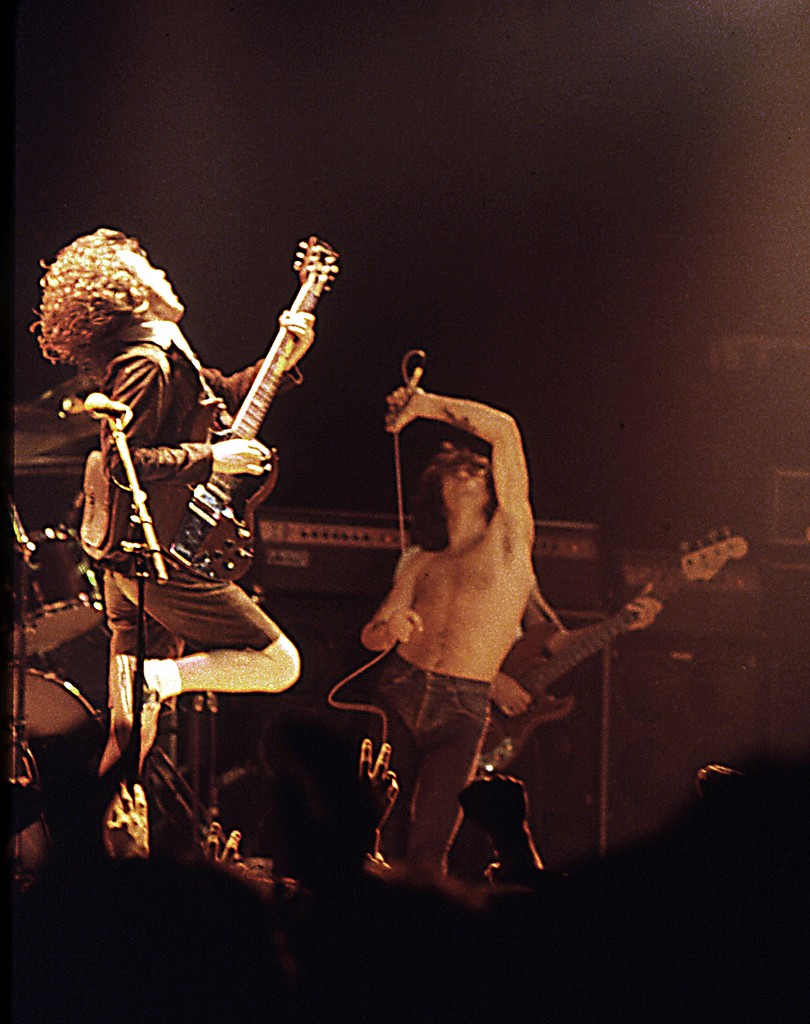
- It’s too loud!!!
- What???
- It’s too loud!!!
- What???
- TOO LOUD!!! *points at ear repeatedly*
- Not loud enough?!?! *reaches for volume*
Rock guitarists like to be loud. Whether it’s the Rolling Stones instructing their fans about the proper way to listen to Let it Bleed – “This record should be played loud,” or it’s Pete Townsend smashing his Les Paul to bits in front of a wall of Marshall stacks while the guitar screams in cascades of anguished feedback, volume has always been integral to the rock sound. There’s a reason that Gibson and Fender began to stick pickups on planks of wood in the 50’s; the genre of music evolving from the blues needed a more dramatic and aggressive sound.
H’ok. So...how do you go about getting that awesome Malcolm-Young-rhythmic-chugging sound in your bedroom? Well, it’s easy enough. A quick Googling tells me that Young uses a Gretsch Firebird and Marshall JTM 45/100 and Superbass 100 amps.

Let’s for the moment assume that you have the requisite dinero to acquire this gear and a youthful spine, unswayed by the travails of a hard life. So you plug your guitar in and turn the amps on, turning the volume knob until you start to hear the amp humming (which is probably right around 1), and you launch into Back in Black...and...what the hell? Why does your amp sound like some beret-wearing jazz musician’s rig? This is a Marshall, right? You double-check the logo to make sure. Yup. What gives?
At this point, it’s a good idea to go back to the Stones’ words of wisdom. Play it Loud! Like all good tube amps, a Marshall needs to be turned up loud for that classic overdrive sound to come out. The only problem is that if you crank a 100 watt head to 10, you’ll be doing a Marty McFly impersonation.

You’ll also be homeless after you’re evicted, or if you’re unfortunate enough to own your domicile, you’ll have to look into how much it will cost to reinforce the structural integrity of your house. The point is that tube amps get mighty loud, mighty fast, but they don’t sound their best ‘til those tubes get cooking.
Yossarian!!!(?)!
Yes, it’s a catch-22.
One workaround is to use an overdrive or distortion pedal, which can simulate the sound of an overdriven amp at a lower volume. Which is all fine and dandy, except for the part where it’s simulating! A more authentic approach is to use an attenuator between your amp and speaker cabinet to attenuate (duh!) the signal after the amp has done it’s tubey goodness at ungodly volumes. This way, your amp gets cooking, creating the overdrive we want, but you can reign in the volume going to your speakers afterwards in order to keep it at neighbour-friendly levels.
Now, all attenuators aren’t the same and I’ve found that with my Marshall JTM45 head, the Dr. Z Airbrake was essentially useless. Even at full attenuation, it was still beyond pant-flapping loud. What did work for me, though, was a THD Hotplate. And boy, did it ever work!

While I happen to have a collection of nice guitar pedals, nothing beats the sustain and feel of a naturally distorting tube amp. There’s a sense of size and majesty that pedals seem unable to duplicate. The touch response is so much better too; strum lightly and you get less overdrive; dig in and you unleash awesomeness. A lot of pedals also have issues with the guitar’s controls. Rolling back the volume gives you a darker, less driven tone, but not a clean tone. With my cranked JTM45, when I roll back the volume, I get instant cleans that sound fantastic.
I had previously thought that having a Marshall stack at home was kind of pointless. Why have a big heavy-lifting amp when you can get a little flea-powered one and some pedals. Well, now I know better. The tones I get from my JTM45 are so much better than what I used to get from my Fender Blues Jr. that the comparison is frankly ludicrous. When you need overdrive, there is no substitution for a cranked Marshall, and something like the THD Hotplate lets you enjoy that sort of wantonness at home.


